A large-scale agile transformation that needed more than a technical deployment.
The client was undertaking an enterprise-wide agile transformation across its technology organization and had engaged OnBizness Group to support the implementation of Jira Align as the portfolio management platform across one of its core business units. Internal teams were in place, but the organization needed an experienced consulting partner who had navigated this type of deployment before and could bring the strategic perspective, preparation discipline, and broader framework that separates a successful enterprise rollout from a tactical tool installation.
Teams had inconsistent Jira configurations, legacy data issues, and no established connection between their day-to-day work and the broader strategic priorities leadership needed to track. Without a structured hierarchy connecting stories, epics, and programs to enterprise themes and focus areas, leadership had no reliable visibility into whether the most important work was actually moving forward. The pre-work required to make the deployment meaningful was significant and had not yet been addressed.
OnBizness Group brought the experience of having done this at scale, the consulting discipline to structure the effort properly from the outset, and the ability to coach and mentor internal teams throughout, building their capability alongside the deployment rather than simply executing tasks on their behalf.
Providing the strategic framework, preparation discipline, and consulting guidance to make the deployment succeed.
-
Team Readiness and Data HygieneGuided internal teams through the standardization of Jira boards, workflows, issue types, and sprint schedules. Coached teams on resolving legacy inconsistencies that would have undermined reliable data synchronization. This work is often underestimated but is foundational to a successful deployment.
-
Enterprise and Program StructureAdvised on the configuration of portfolios, programs, teams, roles, and work hierarchies in Jira Align. Brought the broader strategic lens to ensure the structure connected funding, strategy, and execution rather than simply mirroring existing org charts.
-
Cadence and Planning AlignmentSupported the establishment of program increments, sprint calendars, and team allocations. Helped internal leaders understand the preparation and discipline required to make coordinated planning and consistent reporting a reality rather than an aspiration.
-
Jira to Jira Align IntegrationProvided consulting guidance on mapping Jira projects, issue types, fields, and workflows to Jira Align objects. Advised on integration decisions that would enable real-time synchronization and meaningful portfolio-level rollups rather than surface-level connections.
-
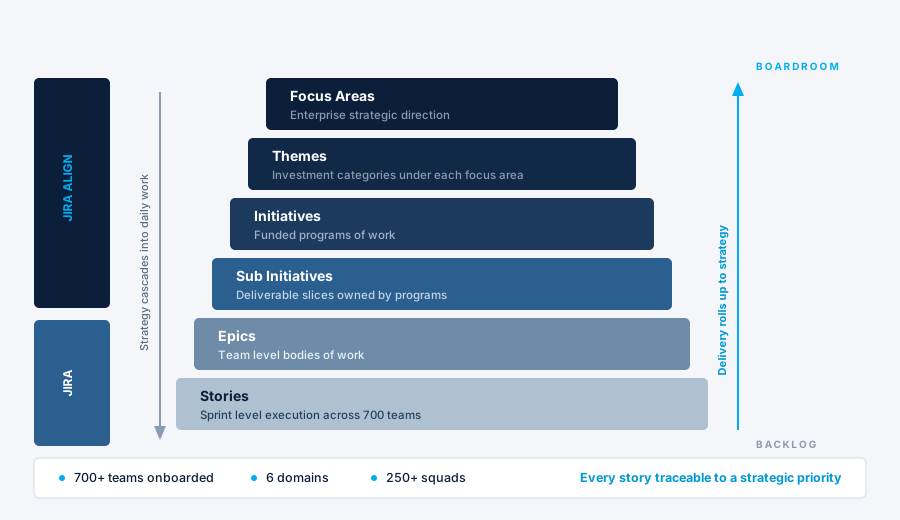
Backlog and Work Hierarchy AlignmentCoached teams on structuring work across stories, epics, sub-initiatives, initiatives, themes, and focus areas. This was a significant change management effort, helping teams understand not just how to configure the tool but why the hierarchy mattered for leadership visibility and strategic alignment.
-
Role-Based Enablement and MentorshipDelivered targeted coaching, training, and mentorship for product managers, product owners, Scrum Masters, Release Train Engineers, executives, and the broader user community. The goal was capability building, not dependency, ensuring internal teams could sustain and grow the practice after the initial deployment.
-
PI Planning and Operating RhythmsAdvised on PI planning preparation and helped introduce governance routines for dependency management, risk review, progress tracking, and portfolio steering. Brought the experience of having established these rhythms in comparable enterprise environments to accelerate what would otherwise have been a lengthy trial-and-error process.
700 teams connected. Strategy visible from the boardroom to the backlog.
The engagement established a connected hierarchy from team-level delivery to enterprise priorities. Stories and epics managed in Jira were linked in Jira Align to higher-level sub-initiatives, initiatives, themes, and focus areas. This gave leadership visibility beyond individual epics, connecting delivery activity to the organization's broader strategic goals.
"Leadership gained visibility beyond individual epics, connecting delivery activity to the organization's broader strategic goals."
OnBizness Group also provided ongoing Jira Align administration, coaching, and support for the user community throughout the engagement, ensuring adoption was sustained and that teams continued to realize value from the platform over time.
This engagement was the first of several with this client. As trust developed, the scope evolved into an ongoing embedded advisory relationship spanning custom application development, resource planning, and cross-functional program support, detailed below.
An organization with no reliable way to see where its time and people were actually going.
As the client's agile transformation matured, a gap surfaced that no existing tool addressed. Work had historically been measured in story points, a unit that could not be compared consistently across teams. Leadership needed a common unit of effort and a system of record for how time and people were actually being spent across the organization, information that did not yet exist anywhere in a usable form.
OnBizness Group was asked to lead the response. Serving as squad leader of a small internal team, the engagement shifted from advising on an existing platform to conceiving and building a new one from the ground up, a shift that reflected the trust the client placed in OnBizness Group's judgment by this stage of the relationship.
The Work-
Concept and BuildConceived and led development of the first version of a purpose-built time tracking application, moving the organization from story points to time as its standard unit of effort. Built with a four person team in approximately three to four months.
-
Organizational IntegrationSynced work items overnight and connected to the organization's internal directory system so each associate defaulted to their correct team and work context, with support for out of area time entry and week to week continuity.
-
Adoption and CompliancePiloted the application over several weeks, then supported mandatory rollout with reporting to drive consistent time entry compliance across the organization.
-
Platform ModernizationLater returned to the application as technical analyst to lead its migration to a modern architecture and its integration with the client's in house portfolio platform, adding validation rules, missed time notifications, manager escalation, usability improvements, and a mobile version.
A build versus buy decision settled by a working product.
The application OnBizness Group conceived and built was successful enough that the client chose to continue developing it in house rather than purchase a third party time tracking tool, a validation of both the solution and the team that delivered it. It scaled to mandatory use across roughly 23,000 associates, with the resulting data feeding directly into the client's financial systems.
"The tool was built to answer one question: where is our time actually going. It ended up answering questions no one had thought to ask yet."
Years after launch, the value continued to compound. In one region, the client used data from the application to substantiate capitalized development costs for tax purposes, an application of the data far beyond its original purpose, resulting in savings in the millions of dollars for tax year 2025 alone.
Knowing where time went was necessary. Knowing where it should go next was the harder problem.
Once the organization had reliable actuals for the first time, a new and logical need followed. Leadership could finally see where resource spend was going and who was working on what, but that visibility was backward looking. The organization still had no structured way to plan how resources would be allocated to upcoming work.
OnBizness Group supported the response as an analyst, working across data, concept design, and application testing for a new resource planning application, initially connected to the same portfolio platform used for the underlying work structure.
The Work-
Data and Concept AnalysisWorked through the underlying data model and planning concept for a forward looking resource allocation capability, building on the actuals foundation the time tracking platform had already established.
-
Application TestingValidated the application against real planning scenarios to ensure the tool gave leaders and teams a reliable way to plan resource allocation for upcoming work, not just record what had already happened.
Actuals and planning, finally connected in one continuous picture.
The resource allocation capability gave the organization a forward looking counterpart to the actuals data the time tracking platform had already made possible. Together, the two systems gave leadership a continuous view spanning what had already happened and what was planned to happen next.
An idea with no answers. A service category that did not yet exist.
The client had a compelling vision: offer offshore tax preparation outsourcing to U.S. accounting firms and CPAs struggling with heavy workloads during peak tax season. The concept addressed a real market need. But at the moment OnBizness Group was engaged, nothing was in place to support it. No technology. No process. No answers to the fundamental questions that would determine whether the idea was viable at all.
The questions were serious and legitimate. How would sensitive client data including Social Security numbers and financial records be protected if tax preparation was happening offshore in India? Would the quality of work meet U.S. tax law standards? Would the service feel impersonal or opaque to accounting firm clients? How would work be tracked, communicated, and managed? How would consistency be maintained at scale?
OnBizness Group was brought in at this exact moment, referred by a KPMG partner and IBM senior director who had direct knowledge of the firm's ability to bridge business strategy, technology architecture, and operational execution simultaneously. The mandate was not to build software. It was to figure out whether this could work, and if so, how.
Solving the core barrier first. Then building everything around it.
-
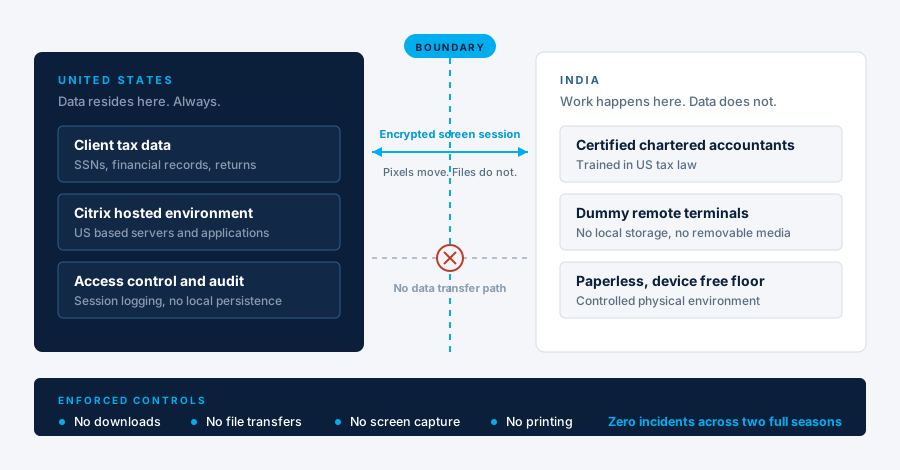
Data Security ArchitectureDesigned a Citrix-based remote terminal access environment hosted entirely on U.S. infrastructure. Certified chartered accountants in India accessed client tax data through secure dummy terminals in a paperless, device-free environment. No downloads, no file transfers, no screen captures, no printing. The data never left the United States. This single architectural decision resolved the core privacy and security barrier that was preventing the service from existing in a form U.S. clients would accept.
-
Process and Workflow DesignWorked closely with the client to define clear end-to-end workflows covering how work was assigned, tracked, reviewed, and communicated. Built transparency into every stage of the process so accounting firm clients had full visibility into the status of their returns without compromising the security architecture.
-
Quality and Consistency FrameworkEstablished quality standards and review processes to ensure offshore preparers, all certified chartered accountants with U.S. tax law expertise, delivered work that met the expectations of U.S. accounting firm clients consistently at scale.
-
Platform Development and LaunchManaged end-to-end development and deployment of the platform, bridging business requirements and technical execution. Supported the platform through two full tax seasons before transitioning operations to the client's own team.
A new service category. Built from nothing. Scaled in three years.
The platform launched and performed. Accounting firms adopted the service because the security architecture gave them confidence that their clients' sensitive data was protected. The process transparency gave them assurance that quality was being maintained. The offshore model gave them the capacity relief they needed during peak season without the overhead of additional U.S.-based staff.
The client is today a recognized and established provider of offshore tax preparation outsourcing services for U.S. accounting firms. OnBizness Group was there at the inception of what has become a viable and growing service category, brought in because of the rare combination of business strategy, technology architecture, and operational execution expertise that the moment required.
The engagement came through a direct referral from a colleague who had worked alongside Julian at both KPMG and IBM. Having seen his capabilities firsthand across both firms, and knowing he was now running his own practice, she connected him with the founder. She knew Julian could handle the business complexity, the technology architecture, and the operational execution simultaneously. That combination was exactly what this challenge required.
This engagement involved a full automation opportunity assessment across multiple business processes at one of the largest financial institutions in the United States. The work included current state process inventory, labor quantification, compliance risk identification, ROI modeling, and future state design. Recommendations were implemented with documented improvements in quality, cycle time, and cost. Full case study in development.
Discuss a Similar Challenge.
If any of these engagements resemble what your organization is working through, let us talk. The first conversation is about your situation, not our services.
Start the Conversation